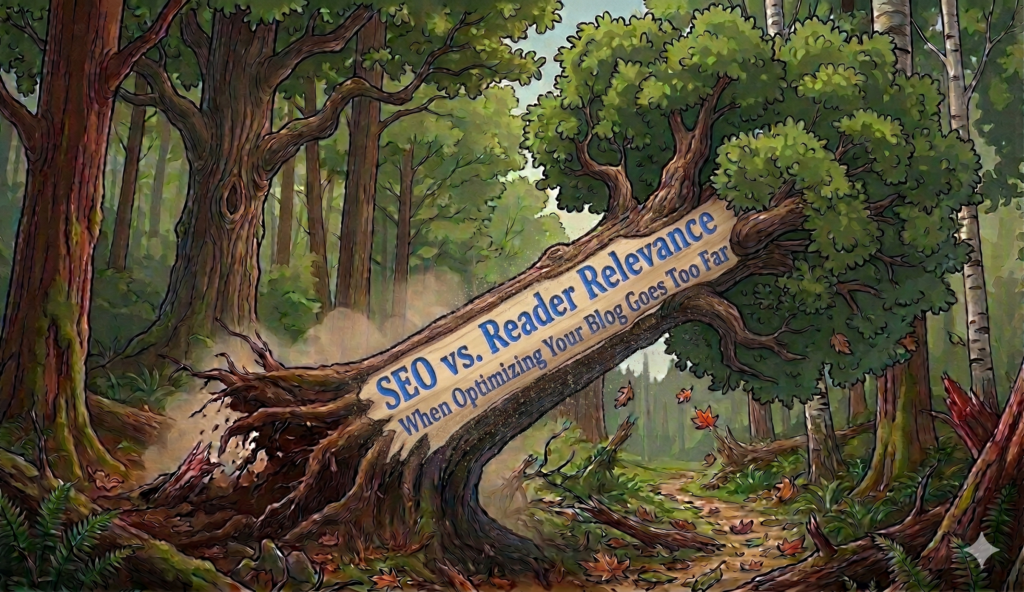
If a tree falls in the forest and no one is around to hear it, does it make a sound? Website owners will often argue that logic when prioritizing search engine optimization for their blog over the reader.
It’s true, without SEO, it may not matter what you say in the article. So, what’s the best way to write blogs that rank for keywords in Google but readers will also find interesting?
Write the Blog You Would Want To Read
Writing a blog you, yourself, would want to read doesn’t mean to disregard your audience’s interest. But obviously, your organization’s mission or business purpose is not only something you are passionate about; it’s something you know about. What would you want to read when you were earlier in your journey?
A blog topic and content that communicates your own voice and interests can build authenticity. Sharing your knowledge can solve problems, provide guidance, and answer reader questions. Also, if you enjoy writing about your interests and what you know, you’ll be more eager to write. And your website’s blog posts will be consistent, genuine and of quality.
- Identify and expand aspects of your blog content that could be interesting and useful to your readers.
- Try a what-I’d-want-to-know approach.
Both SEO and quality content are valuable. Search engines may not find an interesting, well-written blog without basic SEO. An SEO-focused but low-relevance-to-users blog will not hold readers’ interest and will fail to convert users…thereby not ranking due to a lack of engagement.
Here’s a way to choose your topic and focus on the content’s relevance: Imagine posting your blog on social media, and your survival depends on upvotes (likes), shares and comments. Will your blog be a one of many, or is it time to increase your life insurance?
Staying On-Topic: Don’t Forget Who You Are
You might get a wicked number of views if you blog about Ariana Grande. But your website – your digital platform – sells plumbing services. Unless you have a story about unclogging Ariana Grande’s drain, this blog will not only not help; it will likely hurt your SEO efforts.
Who are you? What are your business goals? Your blog must reinforce your website’s purpose, and be true to the author. Here are some characteristics that may align with your brand:
- Building a brand – Showcasing identity & authority to increase trust and credibility
- Community & Social – Connecting people, facilitating
- E-commerce – Online sales
- Entertainment – Recreational amusement; gaming, reels
- Expression – Personal art/projects, essay-blogs, idea-sharing,
- Information – Sharing knowledge, news, resources, etc.
- Marketing – Promoting sales; generating customer leads
- Service – Self-help; professional support
- Social – Facilitating people-connections
The concept of keyword-driven content was developed in the 1990s. Thirty years later, blog SEO continues to depend on keywords and their usefulness. You may feel as if you were born knowing your website’s effective keywords, but too much is keyword-stuffing and that is a bad thing. Don’t do it. Just don’t.
You also need to consider:
- Backlinks – Is your post something someone would want to link back to or share on their socials?
- Internal Links – Internal linking helps Google and AI understand the context of your content. But, don’t just link any anchor text in order to tick the box on your SEO checklist. You also want to consider linking your new content to pages that overlap in BOTH title name and context. For example if I wrote a story about the Boston Celtics I may think of an earlier article about the Subway in Boston to link to. Or, I could link to another article or page about the NBA or how to find Celtics tickets. Contextually, those articles are more relevant.
- Quality or quantity? – You generally want to have 650 words at minimum but if you are passionate about your topic, it’s difficult not to write more. The biggest mistake authors make is to write just for SEO which leads to being too wordy for the sake of including all your ranking terms, for search engines, Google News and Artificial Intelligence Optimization. See what I just did in that last sentence? I fit all my keywords at your expense. That’s if you stuck around and got through it. So, Say what you want to say efficiently without unnecessary information to hit a word count target or keyword stuffing your piece! Keyword stuffing and wordy blogs that wander off-topic can damage your rankings. While avoiding keyword-stuffing, be sure to use at least two keywords in the content. Short paragraphs and bullets give users easier-to-read content that is more quickly processed.
You Nailed It! Now, Grab Your SEO Hat
Finis! You’re sure the blog’s topic and high-quality content meets users’ search intent. It will engage readers and thereby enhance your brand. To guarantee on-page SEO, you must now optimize your blog for SEO… in an organic way. It’s time to make sure someone shows up to hear that falling tree hit the ground.
Add these improvements to boost your blog’s SEO:
- FAQs can improve SEO significantly. They also respond well to AI voice queries, because they offer short and direct answers in the way people ta.
- If anything is slowing your blog page’s load time (more than 3 seconds), now’s the time to find a fix.
- Images and graphics increase visibility and traffic potential, extend on-page time, and improve UX.
- Meta descriptions may not improve your rankings, but they have been proven to increase readership and click-through rates (CTRs).
- Share your new blog on social media immediately to drive traffic.
- Add your CTA in an organic way. Here is an example below which also fits into the flow of this very article!
Magnolia-area businesses and non-profit organizations need a competitive online presence, but we know it can be overwhelming. Modern Marketing and Media’s team of content professionals can customize a dynamic digital strategy that affordably meets your local and digital marketing goals.
You’re not alone in the forest. Contact Modern Marketing and Media today.
FAQs
Two frequently asked questions we receive about content quality and SEO are:
Q: Users’ reading level is important, but how do I know if my blog’s reading level is inclusive?
A: Reading levels vary by industry audience. Ask your local marketing agency which reading level will work best for you and which content analysis software program is best. But as a rule of thumb, you should write the way you speak to your audience in person.
Nothing turns off a reader more than using words like “whilst” and “over yonder” when they know that’s not how you talk.
Q: What are other ways to make my blog reader-friendly and SEO-friendly?
A: There are several options, but using H1 and H2 headers will make your blog crawler-friendly for improved SEO. Also, while avoiding keyword-stuffing, be sure to use at least two keywords in the content. Short paragraphs and bullets give users easier-to-read content that is more quickly processed.